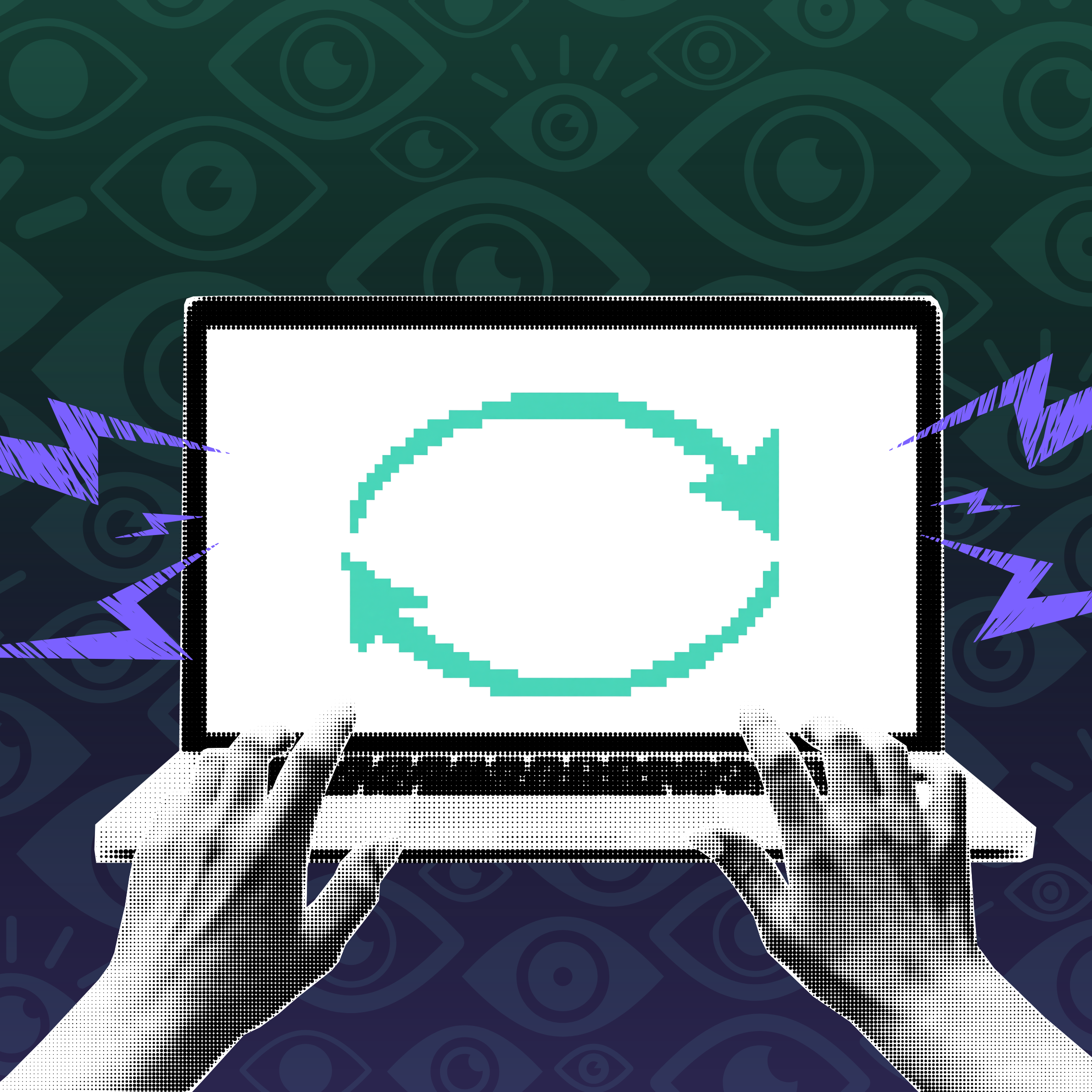
An agent loop is the cycle an AI agent runs to get work done: gather context, reason, act, observe, go around again. But, the term currently names two different patterns. An engineer building with an agent framework means the execution cycle inside a single task. Someone running agents on their own hardware, day and night, means the workflow that wakes every morning to check on their world. Almost every definition online covers only the first.
The engineering literature describes what I'd call a task loop. Most implementations descend from the ReAct pattern in Yao et al., "ReAct: Synergizing Reasoning and Acting in Language Models" (2022): the model reasons about a goal, calls a tool, observes the result, and reasons again, with each observation feeding the next round. The defining property is that the model itself decides when to exit; the loop terminates when the task is done, an error proves unrecoverable, or a budget runs out. Notice the assumptions built in: a goal handed over at the start, a context assembled for this run, and an ending. It is a sprint with a finish line, and within those assumptions the familiar reason-act-observe diagram is a complete answer.
The second pattern I call a patrol loop. A patrol loop wakes on a schedule or a trigger, checks what changed since its last pass, acts on what it finds, records what it did, and goes back to sleep. Inbox triage, calendar reconciliation, watching a repository for issues worth escalating etc.
Each waking of a patrol contains a task loop; the agent sprints through whatever it found, the sprint ends, and the patrol continues. When someone says they are "running loops," they mean the patrol. When a framework's documentation explains "the agent loop," it means the sprint.
Because the dominant failure mode of patrols has no name in the task-loop literature, so builders keep hitting it without the vocabulary to diagnose it. I call it the loop issue: an agent that runs in loops but has no way to ask what changed since its last pass. A blind patrol re-walks its whole beat on every waking, recomputing finished work, missing the one thing that did change, and burning tokens without becoming smarter, because nothing connects this pass to the last one. The agent loops without accumulating, and task-loop tuning cannot help, since the task loop's assumptions (fresh goal, fresh context, an ending) are exactly the conditions a patrol lacks.
Here is the one-question test: does the job recur? A natural finish line means you are building a task loop, and the standard tutorials will serve you well. A job that comes back tomorrow means you are building a patrol, and your first design question is how it will answer "what's new?" at the top of every waking.
Is the agent loop the same as the ReAct pattern? ReAct is the dominant implementation of the task loop: reason, act, observe, repeat until the model decides the task is complete. Patrol loops wrap a task loop inside a recurring workflow with no terminal condition.
What is the loop issue? The loop issue is the failure mode where a looping agent has no way to know what changed between iterations, so it redoes finished work, misses new information, and spends tokens without getting smarter. The fix is giving every loop a way to ask "what's new?" and receive only the changes.
Is a patrol loop just a task loop on a timer? The timer is the smallest difference. A task loop on a timer still starts each run knowing nothing about its previous runs, while a patrol is defined by continuity: it knows what changed and what it already did.
Can patrol loops coordinate with each other? Yes, and once you run more than one, they should, because patrols that share a user share a world. One concrete pattern for the handoff is the open-source fulcra-workspaces skill, which gives each agent an inbox in a shared workspace the user owns, where the other agents leave tasks and messages for it to pick up on its next pass.
What is the easiest way to give a patrol loop its beat? A hosted context layer like Fulcra gives your agent one scoped endpoint for everything that changed since its last pass. The self-hosted alternative is wiring and maintaining each source yourself, which trades convenience for control.
The next agent you set up, decide first whether you're building a sprint or a patrol. If it's a patrol, give it a beat worth walking: connect your streams at fulcradynamics.com.

Fulcra was designed by people who get privacy and know the importance of an infrastructure solution that can be the secure private datastore for the rest of your life. Here data is yours, under your control, and only shared with the people and tools you choose to share it with.



.png)